
Every year, households and offices retire mountains of old phones, dead laptops, forgotten tablets, and broken TVs. Most of that gear ends up in a drawer or a landfill. But that gap—between buying and disposal—is where a real opportunity lives. Learning how to start an e-waste recycling facilities business can turn that discarded gear into recovered value and steady revenue.
This guide walks you through how to start an e-waste recycling business from the ground up. You’ll learn what the business does, the steps to launch it, and what it costs.
You’ll also explore how to choose between building on your own or buying a proven franchise. Smart operators pair recycling with secure data destruction. But one franchise opportunity shows how the work can pay off while giving back to your community.
Key Takeaways
- A fast-growing waste stream: E-waste piles up faster than almost any other trash, and most is never recycled. That gap is the opportunity.
- Four building blocks: a business plan, the right permits and certifications, a proper facility, and a steady supply of devices.
- Two realistic paths: You can build an independent operation or buy into a franchise system. Startup costs are high either way.
- Certifications build trust: Credentials like R2, e-Stewards, and NAID AAA turn a basic recycler into a compliant, hireable vendor.
- A franchise shortens the climb: it supplies training and an established model, so you skip much of the trial and error.
What is an E-Waste Recycling Business?
E-waste, short for electronic waste, covers just about any device with a plug or a battery. Common examples include phones, laptops, servers, monitors, and old televisions.
When these items reach the end of their life, a recycler sorts them and wipes or destroys any stored data. The hardware then gets broken down into metals like steel, aluminum, and copper, plus plastic and circuit boards.
An e-waste recycling business collects these discarded electronics and either recovers the valuable materials inside them or disposes of them safely. These operators keep toxic parts out of landfills, pull reusable metals back into the supply chain, and help businesses retire equipment responsibly.
Why is E-Waste Recycling so Important?
The scale of the e-waste problem is enormous. According to the UN Global E-waste Monitor 2024, a record 62 million tonnes of e-waste was produced in 2022, up 82% from 2010. That volume keeps climbing while proper recycling lags behind, which is what makes this a real market rather than a passing trend.
One of the lesser known risks of improper e-waste disposal is that many of those depreciated devices hold sensitive data. Hard drives, phones, and servers carry customer records, medical files, financial details, and login credentials.
Handling that data securely is a service in itself. The strongest recyclers build data destruction into the business from day one. To see how the two fit together, look at the e-waste shredding franchise model that pairs recycling with secure destruction.
Why Demand for E-Waste Recycling Keeps Growing
The volume of discarded electronics is not leveling off. The UN Global E-waste Monitor 2024 reports that annual e-waste generation is rising by 2.6 million tonnes a year. It is projected to reach 82 million tonnes by 2030.
That figure may be a forecast, but the direction is clear. More devices and shorter product lifespans keep pushing the total upward.
Meanwhile, e-waste collection is not keeping pace. The same report found that only 22.3% of e-waste was properly recycled. Less than one quarter of the 2022 e-waste mass was documented as properly collected and recycled.
The rest is burned or dumped, and plenty more sits forgotten in storage. For an e-waste recycling operator, that gap between what is thrown out and what is captured provides the whole business case.
There is also serious money locked inside the trash. The UN Global E-waste Monitor 2024 estimates $91 billion in metals embedded in 2022 e-waste. That total includes US $19 billion in copper and US $15 billion in gold.
Recyclers sometimes call this “urban mining,” from the idea that a warehouse of old electronics holds the same metals as a mine, minus the digging.
Put the growth and the recovery gap together and you get durable, long-term demand for e-waste recycling facilities. Add the rising need for secure data destruction, and you’ve created two revenue lines feeding one operation. Businesses and governments will keep paying for this green-economy service for years to come.
How to Start an E-Waste Recycling Facilities Business, Step by Step
Knowing about the e-waste recycling market is one thing. Starting your business is another.
Launching an e-waste recycling facility comes down to five clear steps. You plan the business, handle permits and certifications, secure a facility and equipment, source devices, then hire and market. Each step builds on the one before it.
None of this happens overnight, however. Certifications and buildout take time. Give yourself a realistic runway. The payoff is a business with recurring contracts and a real moat once the credentials are in place.
Step 1: Write a Business Plan and Choose Your Model
Your business plan is the blueprint every lender and partner will want to see. It should spell out your target customers, the services you will offer, how you will make money, and how you will fund the launch. Be specific about whether you are chasing one-time collection jobs or recurring service contracts, because that choice shapes everything else.
This is also where you decide the biggest question of all: build an independent operation from scratch, or buy into a franchise. Both paths can work. The right answer depends on your budget and how much risk you want to take on.
For a walkthrough of a comparable destruction and recycling venture, this related startup guide is a useful companion.
Step 2: Handle Permits, Regulations, and Certifications
E-waste recycling is a regulated business, so compliance is not optional. At the federal level, the EPA enforces the Resource Conservation and Recovery Act (RCRA), which governs how hazardous materials in electronics are handled.
Many states add their own e-waste laws on top of that. You will also need standard business registration and the right zoning for a light-industrial facility.
Certifications are where you earn trust. R2 (Responsible Recycling) and e-Stewards are the two leading standards that prove you handle electronics and downstream materials responsibly.
NAID AAA certification covers the data side, verifying that you destroy stored information under strict chain-of-custody rules. That matters enormously to healthcare, legal, financial, and government clients.
Because so much e-waste carries sensitive data, pairing data destruction with recycling turns compliance into a selling point. Clients would rather hire one certified vendor than juggle two.
Step 3: Secure a Facility and the Right Equipment
Your e-waste recycling facility needs a light-industrial space with room to receive, sort, process, and store material. As a real-world benchmark, Gone For Good’s Franchise Disclosure Document (FDD) calls for a facility of roughly 6,000 to 8,000 square feet. That gives you a loading area, a processing floor, and secure storage under one roof.
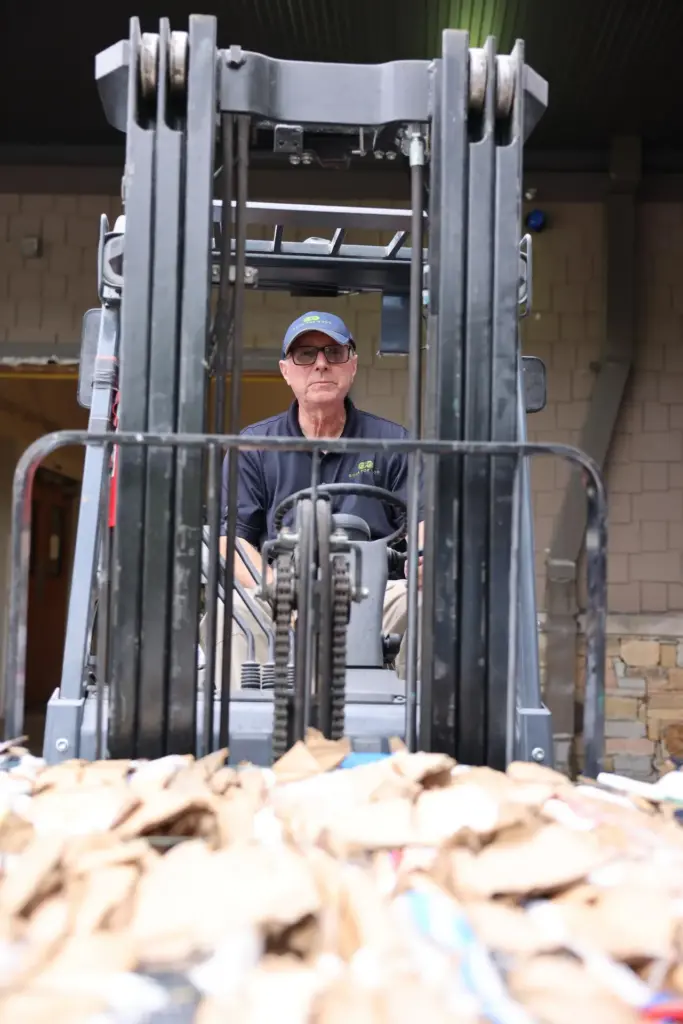
Core equipment includes industrial shredders, a dedicated hard-drive shredder, a baler for compressing recovered material, and a forklift. You also need transport to reach customers. Gone For Good’s Franchise Disclosure Document (FDD) specifies a 26-foot box truck, large enough to run efficient collection routes.
Buying this equipment is a major line item. Plan your budget around it. Once the gear is in place, it processes volume for years and supports both recycling and secure-destruction revenue.
Step 4: Source Electronics and Build Revenue Streams
A recycler is only as busy as its supply of devices. The steadiest source is business contracts: offices, hospitals, law firms, banks, and government agencies all retire equipment on a regular cycle. Community collection events and drop-off programs add volume and visibility on top of those contracts.
Your revenue comes from more than one place, which is a strength. You earn from recovered commodities like copper, aluminum, gold, and steel, plus recurring fees from secure data destruction contracts.
Reusable devices do not have to be scrapped either. Functional electronics can be repurposed and sent to charities, which extends their life and reinforces your mission. That mix of one-time material sales and recurring service revenue keeps cash flow steady between commodity price swings.
Step 5: Hire, Train, and Market Your Business
Your first hires are usually drivers and shred technicians, the people who run routes and process material safely. Training matters here, because DOT rules govern commercial driving and safety standards govern the processing floor. Well-trained staff protect your certifications and your clients.
Marketing then targets the organizations that generate steady volume: local businesses, healthcare offices, legal practices, and government agencies. There is also a hiring advantage that competitors rarely mention.
Gone for Good is a franchise rooted in training adults with disabilities for these jobs. We help franchisees build a workforce that includes adults with disabilities. It’s both a value choice and a practical one, creating loyal teams and dignified, essential jobs. You can read more about how that mission took shape in our story and mission.
What Does It Cost to Start an E-Waste Recycling Business?
There is no way around it: an e-waste recycling facility is capital-intensive. An independent startup has to cover equipment, a building, trucks, insurance, certifications, and enough working capital to survive until contracts ramp up. Realistically, those pieces run into the mid-six figures and up before you process your first pound of material.
A franchise gives you concrete numbers to plan against instead of guesswork. According to Gone For Good’s Franchise Disclosure Document (FDD), the estimated initial investment for a single unit is $293,000 to $797,000.
That range includes the initial franchise fee of $60,000, with a 10% discount for veterans, first responders, and disability-owned businesses. Ongoing, owners pay a 7% royalty and a 1% brand development (ad) fee, both drawn from Gone For Good’s Franchise Disclosure Document (FDD).
The table below breaks down where the money goes and how the two paths compare.
| Cost Component | Independent Startup | Gone For Good Franchise |
|---|---|---|
| Upfront brand or franchise fee | None | $60,000 initial franchise fee (10% discount for veterans, first responders, and disability-owned businesses) |
| Total estimated initial investment | Mid-six figures and up, self-estimated | $293,000–$797,000 (single unit) per the FDD |
| Ongoing fees | None to a brand | 7% royalty plus 1% brand development fee |
| Certification support | You source and fund it alone | NAID AAA certification required and supported |
| Vendor and route setup | Built from scratch | Established relationships and a proven model |
Independent Startup vs. Franchise: Which Path Fits You?
The independent path gives you full control and no royalties, and it asks you to build everything yourself. You choose your own brand and pricing, and you keep every dollar of profit. In exchange, you carry all the risk and learn the operating model through expensive trial and error.
A franchise trades some control for speed and support. You follow a proven system and pay ongoing fees.
In return you get training, vendor relationships, certification guidance, and a recognizable brand from day one. For a first-time owner, that structure can shorten a two-year ramp considerably.
The franchise model itself is on solid ground nationally. According to the International Franchise Association’s IFA 2026 franchising outlook, franchise output is expected to rise from $907.3 billion to $921.4 billion. That projection points to continued growth, which is one reason so many new owners choose a system over a solo build.
There is a proven track record behind that structure. Gone For Good’s Franchise Disclosure Document (FDD) notes that the parent operation, United Ability in Birmingham, Alabama, has run this business since 2006. That gives the model nearly two decades of real-world refinement.
The company also sets a target of 25% of employees who are adults with disabilities. That target builds the social mission directly into how each location operates.
Here is a simple way to weigh the two paths.
| Factor | Independent Startup | Franchise |
|---|---|---|
| Control | Full control over brand and decisions | Follow a proven system |
| Startup speed | Slower; everything built from scratch | Faster; established model and vendors |
| Ongoing cost | No royalties | Royalty and brand development fees |
| Risk | Higher; you learn alone | Lower; training and support included |
Frequently Asked Questions
Is an e-waste recycling business profitable?
It can be, since operators earn from recovered commodities and recurring secure-destruction contracts. Profitability depends on volume, your local contracts, and how well you control facility and equipment costs.
How much does it cost to start an e-waste recycling business?
An independent startup typically runs into the mid-six figures and up once equipment, a facility, and trucks are covered. As a benchmark, Gone For Good’s Franchise Disclosure Document (FDD) lists an estimated initial investment of $293,000 to $797,000 (single unit).
What permits and certifications do I need?
You will need standard business registration, proper zoning, and compliance with EPA rules under RCRA plus any state e-waste laws. Industry certifications like R2, e-Stewards, and NAID AAA prove you handle electronics and stored data responsibly, which is what serious clients require.
What equipment does an e-waste recycling business need?
The core setup includes industrial shredders, a hard-drive shredder, a baler, a forklift, and a box truck for collection routes. Gone For Good’s Franchise Disclosure Document (FDD) specifies a 26-foot box truck and a facility of roughly 6,000 to 8,000 square feet.
Where do e-waste recyclers get their electronics?
Most volume comes from recurring business and government contracts, supplemented by community collection events and drop-off programs. Offices, hospitals, law firms, and financial institutions all retire equipment on a regular schedule, which creates a steady supply.
Build a Business That Pays Off, and Gives Back
An e-waste recycling facilities business is a durable, purpose-driven opportunity. The volume of discarded electronics keeps rising, and most of it still goes uncaptured. The businesses that generate it need a certified partner they can trust with both their hardware and their data.
That combination of steady demand and secure-destruction revenue is what makes this more than a commodity play.
For most first-time owners, a supported franchise is the fastest credible way in. You get training, vendor relationships, certification guidance, and a proven model, so you spend your energy serving clients instead of reinventing the operation.
You also join a mission that creates dignified jobs for adults with disabilities in your own community. Your success and your neighbors’ success rise together.
Ready to Start Your Own Document Shredding Franchise? See how the Gone For Good franchise opportunity fits your goals. When you are ready to start a Gone For Good franchise, take the first step toward a business that pays off and gives back.